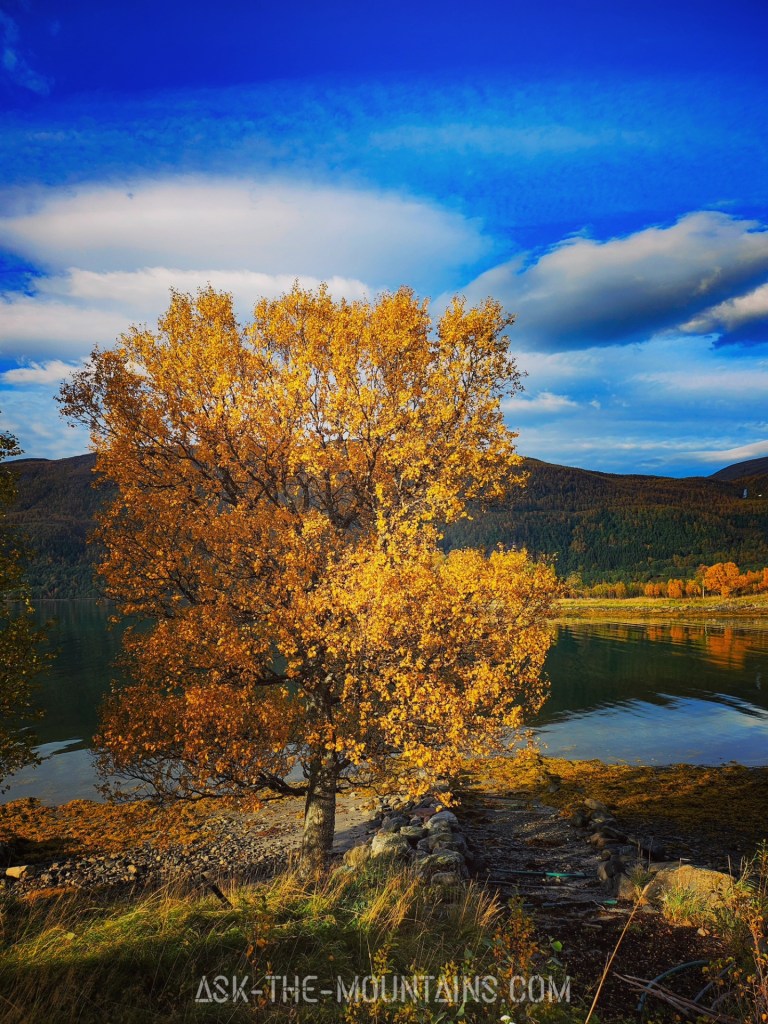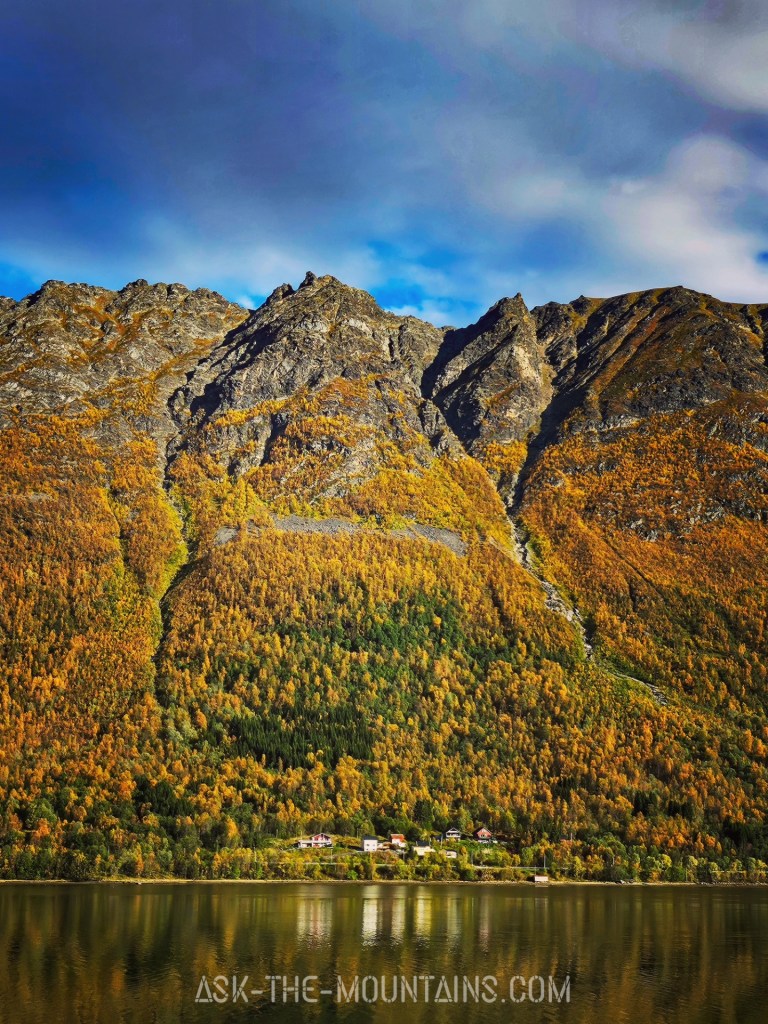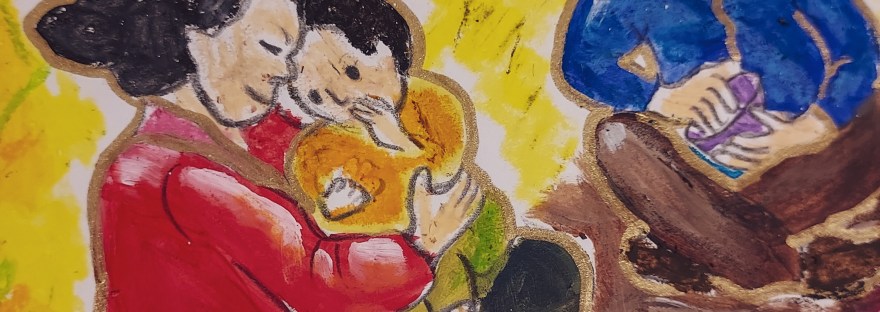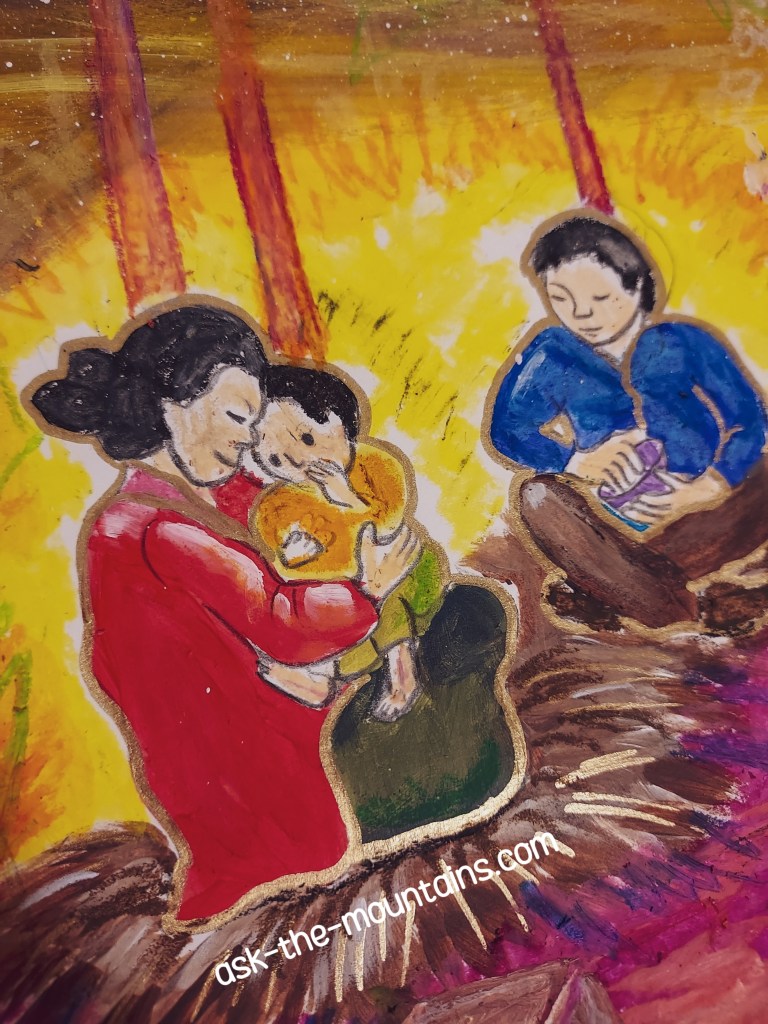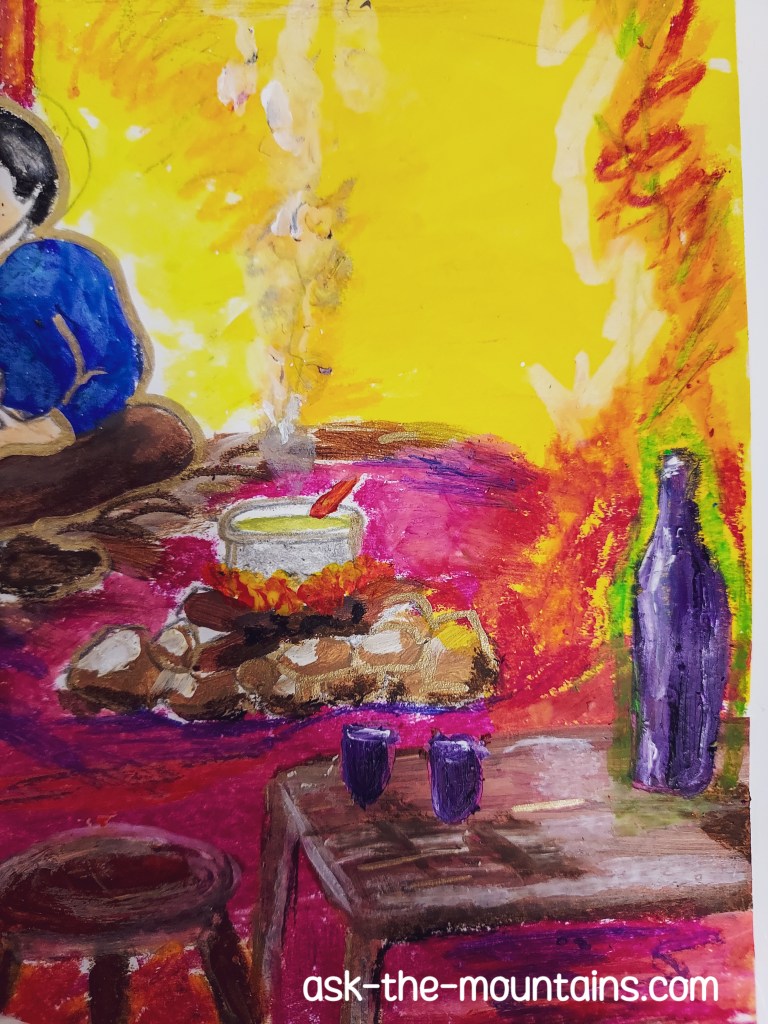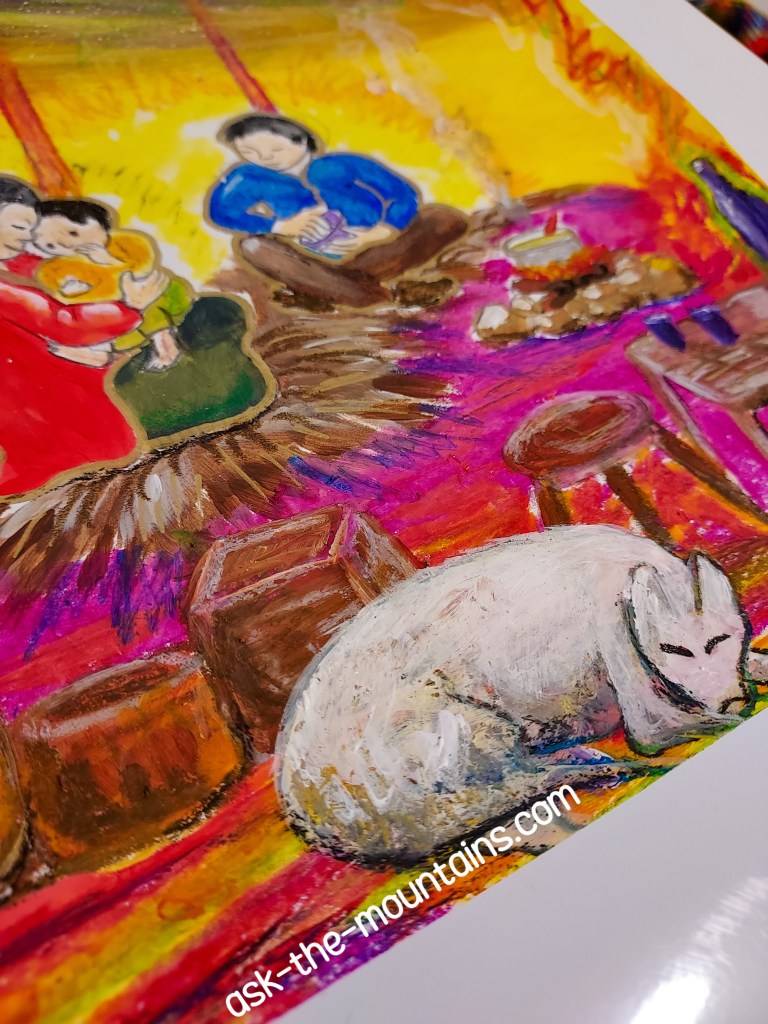
If you knew that one day someone would be helped and inspired by exactly the trial you are going through now, would it then be easier to bear? I believe that the knowledge/thought that another person can benefit from your story; your experiences and how you solved problems and trials makes the burden lighter in a way; because then you are doing something for something greater than yourself. There is a self-sacrifice in the picture that gives momentum, and you no longer think only of “me and mine,” but also of the well-being of others. I don’t know if this makes sense – I think it’s the autumn and the colourful death and devotion of the plants to the cycle of the seasons that made me write this 🤭🍂💛
The Sacred Bear and “the Origin of the Sámi People”
In Sámi mythology, the bear is a divine ancestor, not just an animal.
One myth tells of a heavenly bear who descended to earth and married a human woman. Their children became the first Sámi people.
Because of this, bears were/are honored as ancestor spirits, and when a bear was killed (very rare and ritualised), its bones were carefully placed in a tree to allow its soul to return to the sky.
A ceremony called the Bear Feast included songs, dances, and apologizing to the bear spirit for the killing, inviting it to be reborn.
The Bear Who Fell From the Stars:
A Sámi Creation Song of the First Bear
In the hush before dawn, where no footprints fall, Where the wind hums secrets to the pine, A star broke loose from the roof of night And tumbled down through time.
He fell with a roar through clouds of gold, Bathed in *Beaivi’s light. He landed not dead, but dreaming still In the heart of the forest’s white.
The reindeer bowed their crowned heads low, The lynx stood still in her track. For this was the First of Bears, The Sky-Child, fallen back.
He walked like thunder on ancient snow, His breath, a wind of flame. Yet gentle were his dreaming eyes, And wise, and without shame.
A woman came from a northern vale, A weaver of skins and song. She found him sleeping in a ring of birch And stayed with him all night long.
They spoke without words by fire and frost, By the rhythm of blood and bone. She taught him the names of the winds and streams; He gave her dreams of home.
And so their children, wild and wise, Were neither beast nor man. They sang to trees, they hunted clean, They walked where few else can.
But then the bear, when spring had sung, Felt longing rise like steam: His fur grew light, his eyes grew wide He vanished into dream.
And so today, when the bear is seen, The Sámi bow and sing “Child of stars, our ancient kin, Return again in spring.”
If ever a bear is taken in hunt, The people weep and pray. They dress his skull in flowers and moss And lift his bones away.
A zen tradition that doesn’t separate buddhanature from substrate consciousness (skt. alaya vijnana), doesn’t speak or teach kensho but then claims to be able to just sit (j. shikantaza), that doesn’t have one on one instruction (j. sanzen/dokusan), that has no emphasis of any type of dynamicity or physicality in training, where lineage blessings go unnoticed, where students and roshis spend sesshin after sesshin half asleep, has got to be the most decadent form of Zen to ever exist. These are the very problems that Bodhidharma corrected by teaching the weak, sleepy and ignorant meditation monks dynamic movement practices but also how to transform, stretch and strenghten tissues (c. yijinjing) and how to transform all three bodies from samsaric to nirvanic state (c. xisuijing, bone marrow washing). It’s been long since Bodhidharma’s time but the state of some systems that claim to be zen buddhism merely based on lineage transmission and mimicked external form, proves that the deluded mind is master in deluding itself, without much ability to learn from the mistakes done by others. It is indeed difficult to find practitioners who are able to analyze and extract the essential meaning of dharma thus demonstrating abundant merit (skt. punya).
Baba, Revitalized Zen 16 March 2025
Yes, this seems to be true; that the state of Zen lineages today is simply not producing Masters, as was the whole point of Zen training. The state of Dharma is seemingly in a bad shape all around. Therefore, I find it very refreshing and interesting to read such quotes as the one above. Here is the YouTube channel of Revitalized Zen, the facebook group and here is the blog. Excellent reading for any spiritual seeker 🙏🏼🪷
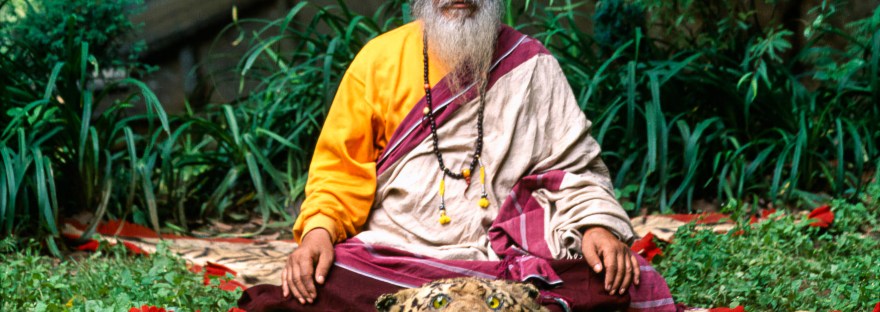
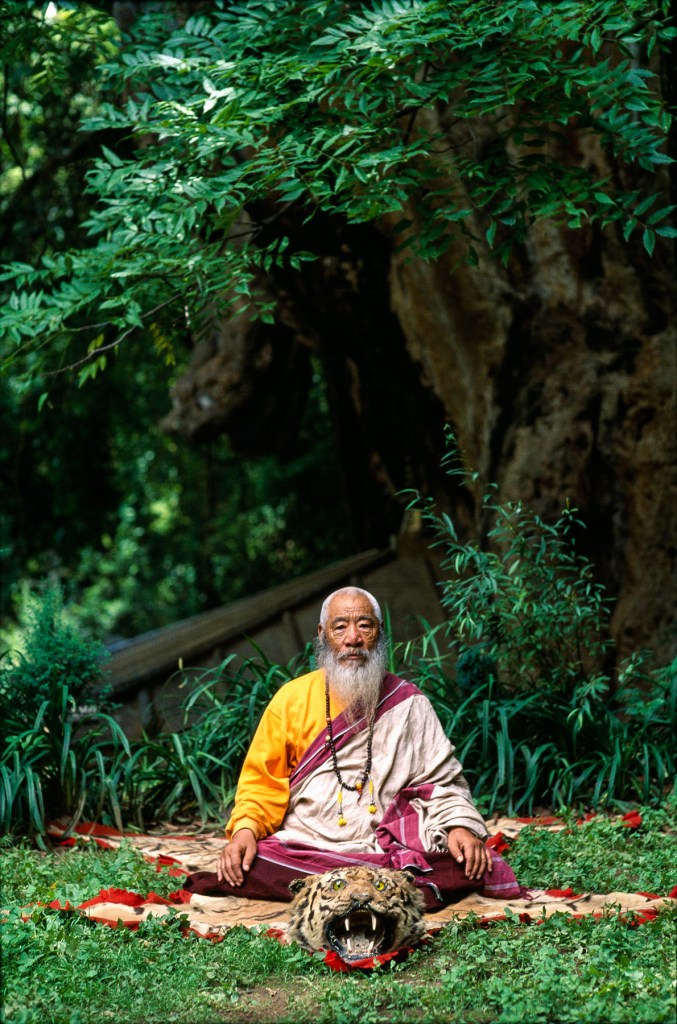
Chatral Rinpoche (8. June 1913 – 30. December 2015). Yogi whom has helped me on my spiritual path 💎📿
You might spend your whole life pursuing only food and clothing, With great effort and without regard for suffering or harmful deeds, But when you die you cannot take even a single thing with you — consider this well. The clothing and alms needed to keep you alive are all you need. You might dine on the finest meal of delicious meat and alcohol, But it all turns into something impure the very next morning, And there is nothing more to it all than that. So be content with life-sustaining provisions and simple clothes, And be a loser when it comes to food, clothing and conversation.
No matter where you stay, be it a busy place or a solitary retreat, The only things that you need to conquer are mind’s five poisons(jealousy, pride, anger, ignorance, attachment). And your own true enemies, the eight worldly concerns(hope for pleasure and fear of pain, hope for gain and fear of loss, hope for praise and fear of criticism, hope for good reputation and fear of bad reputation).
There is no better sign of accomplishment than a disciplined mind. This is true victory for the real warrior who carries no weapons. When you practise the teachings of the sūtras and tantras, The altruistic bodhicitta of aspiration and application is crucial, Because it lies at the very root of the Mahāyāna. Just to have this is enough, but without it, all is lost.
It is far better to eliminate your doubts and misconceptions, By relying on the instructions of your own qualified teacher, Than to receive many different teachings and never take them any further.
If you lack the wealth of contentment in your mind, You’ll think you need all kinds of useless things, And end up even worse than just an ordinary person, Because you won’t manage even a single session of practice. So set your mind on freedom from the need for anything at all. Wealth, success and status are all simply ways of attracting enemies and demons. Pleasure-seeking practitioners who fail to turn their minds from this life’s concerns Sever their connection to the authentic Dharma.
Limit yourself to just a few activities and undertake them all with diligence. Not allowing your mind to become fidgety and restless.
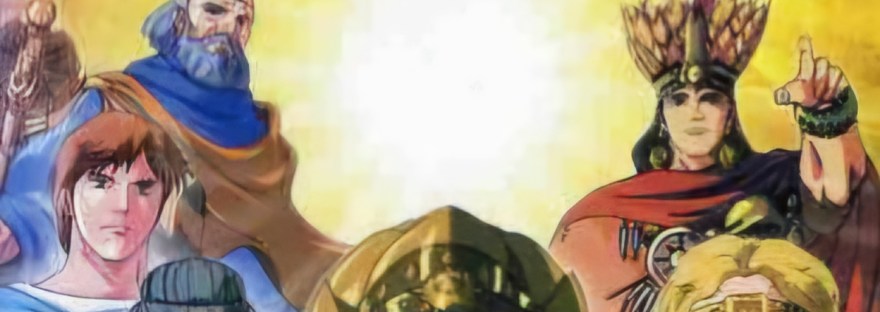
Have to share this absolute gem of a film 🙏🏼 Found it very well made and entertaining to watch, and a good Dharma film to show kids. I don’t usually watch a lot of animé but I liked it!
Really enjoyed this 2 hour interview with “the smarteste man in the world”. Of course IQ isn’t everything, as he says himself, but I guess what I liked about this interview is how he early on in life decided to look for truth and meaning rather than using his brains to make money. They got into all sorts of topics, like beauty, reality, globalism, God, even aliens, cancel culture, etc. Very relevant atuff. Also, I found it funny how he said most buddhists nowadays don’t understand emptiness/sunyata, I think that is true.
“Pregnancy is a process that invites you to surrender to the unseen force behind all life.” 💚🧡🤍🩵 Photos taken by Gunhild Berg Johansen, I was ca 6 months pregnant here.
I highly recommend this very helpful and insightful podcast episode on breaking the fear-tension-pain cycle that most women go into when in labour, myself included. I am very close to giving birth to our second child, and feeling all the emotions that comes naturally leading up to that. This podcast episode really helped me, along with a hypnobirthing course I’ve been doing lately.
When we are small children, it comes natural for us to think of others. We don’t see much separation between ourselves and others, and so wanting to be kind, to help and be generous comes as naturally as dusk and dawn.
As we age and experiences shape us, we get hardened. We are no longer soft and supple like babies, now we have frozen places in our bodies and mind that makes us feel and act in certain negative ways, or it even makes us ill. We get prickly edges, we might be ‘difficult’ for others to be around and as much as we wish to feel soft, authentic and playful again, it just don’t seem to happen by will alone.
This is where yogic practices (dharma) can help, because it targets and addresses both the physical body, and the subtle energy bodies. Focusing only on one aspect, will not be a holistic solution, in my experience. And focusing only on my own healing, without regard to others who are also suffering, is not sufficient; it has to be for the benefit of others – it has to touch the heart (bodhichitta).
Prayer flags in our garden
Here is the youtube channel and the website of the Amrita Mandala dharma lineage which I practice and which has helped me the most in my life and healing 🙏🏼
Yogi on display in nature for the birds, foxes and rabbits to see 😄 also i found a long-ish animal bone that was perfect to use for hitting on a rock to keep the rhythm while chanting and singing prayers. 🐰🐦🦊🦴
What is #YogisOnDisplay?
“Unlike in cultures long established in the dharma, spiritual practice is not visible in the everyday life of Western society. While many Westerners practice some form of spiritual practice, the actual practice is often kept private. This is a great pity. Not only does it speak volumes about the level of spiritual maturity of the West, but it also means that many people never encounter dharma in the first place. If spirituality is not publically displayed, the fact that there is an alternative to existential confusion and suffering does not reach the masses.
In an attempt to counter this, Amrita Baba has initiated the Yogis on Display project. The idea behind Yogis on Display is to encourage spiritual practitioners of the West to become living examples for others. Instead of hiding away in our modern city caves, we need to bring meditation, mantra singing, yoga practice, and so on, directly to where it matters; straight to the middle of the hamster wheel. Displaying the solution to existential confusion and suffering is a hands-on, time-tested way of practicing care and compassion for all beings.

To spread the message of Yogis on Display the hashtag #yogisondisplay has been created. Practitioners who chose to take part are encouraged to take a picture of themselves and share it on social media using this hashtag. This way more people can learn about the initiative and become inspired to light the torch of dharma in our public spheres.” (AmritaMandala.com)
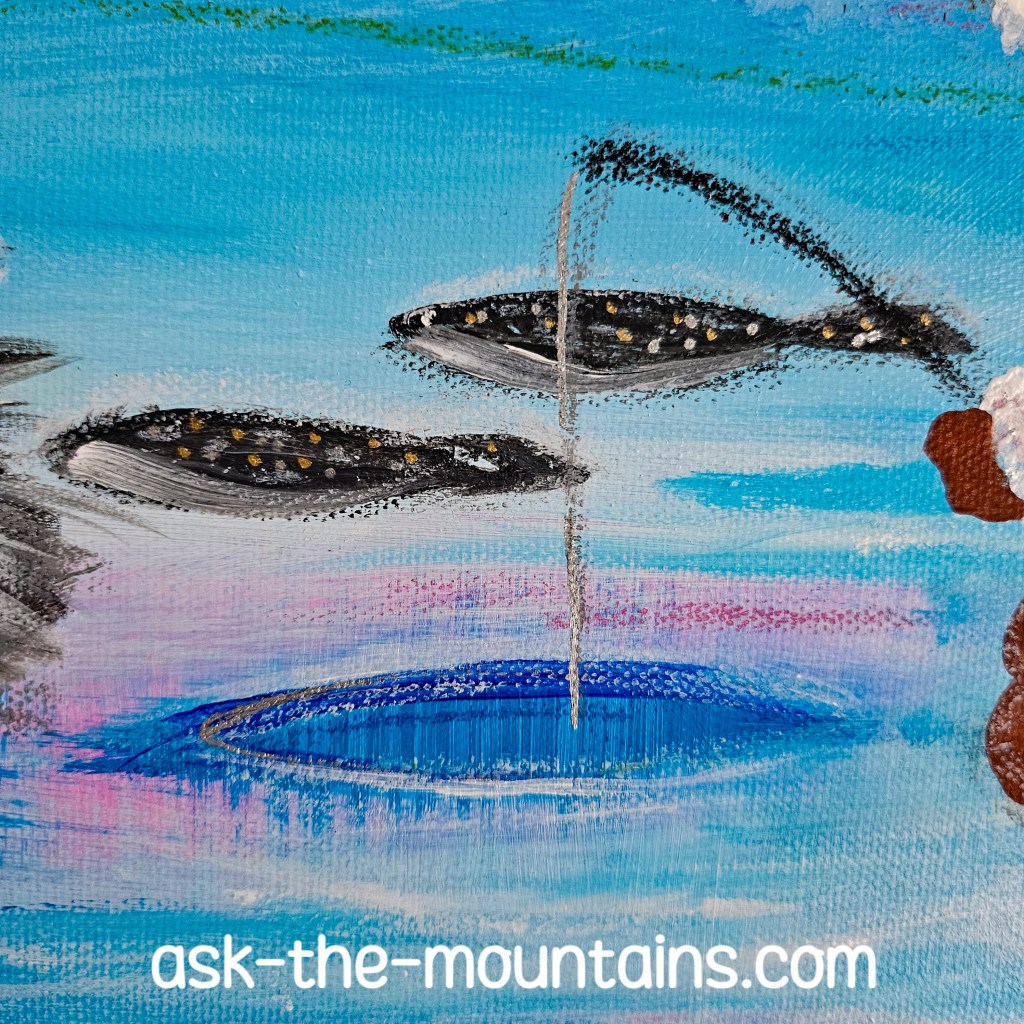
Food and how to get that food is a huge part of any culture. In the Arctic, that food culture has been mainly catching, hunting, fishing and herding, making the foundation of our food for thousands of years an animal based one. We don’t have a lot of local edible plants here, with a few exceptions like berries for example. With the influx of trading and new borders, new foods were introduced, but if you are like me, I don’t tolerate them well at all, especially grains, and a lot of carbs . So I stick to an ancestral Arctic diet that my stomach and body loves, and I feel extremely passionately about food culture, so I guess that is what I made this painting about. I also added 3 samoyed sled/herding dogs, as a little head nod to another Uralic Arctic people neighbouring Sápmi; the Nenets. (An obsolete name for them used to be the Samoyed people, a name not used by themselves). Acrylic on 80 x 80 cm canvas, details in silver and gold pen, oil pastel crayons. 🩷🩵💜🤍💚
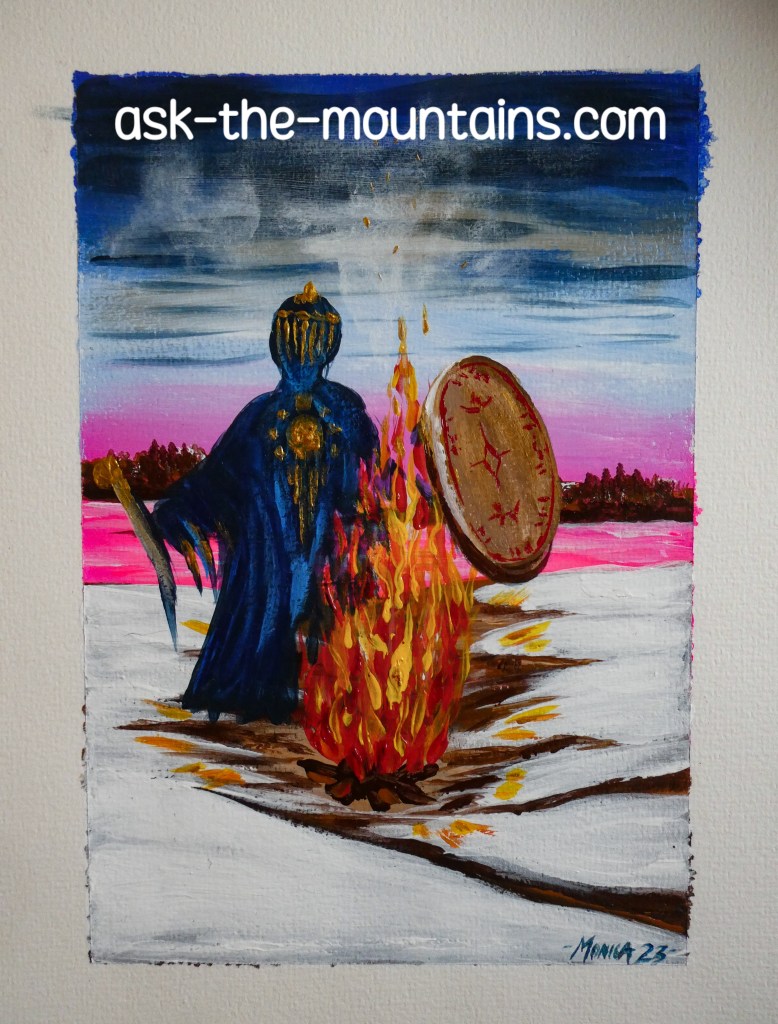
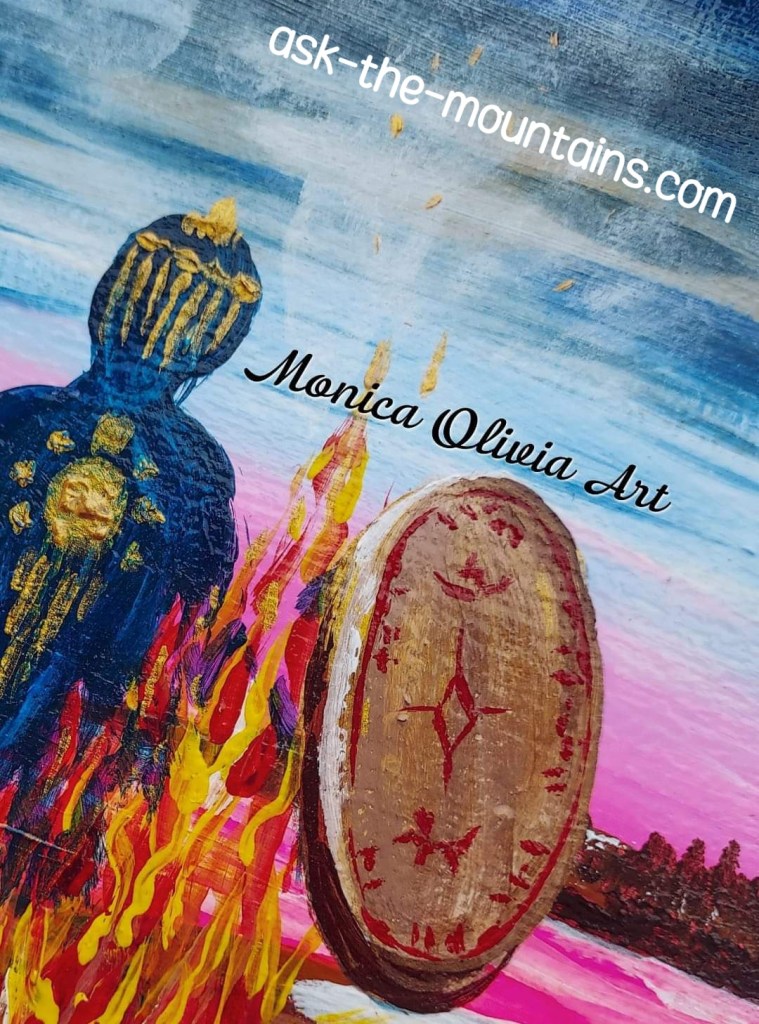
It is from Eastern Siberia that the word shaman comes from, which means to ‘heat up’. Where it originated before that, I do not know. The ‘new shananism’ people in the west speak of today can hardly be compared. Shamanism and animism has permeated most if not all of the nomadic and semi-nomadic cultures in this part of the world. The shamans have traditionally been both women and men, though the word ‘shaman’ is masculine form. The feminine word for a female shaman is ‘udugan’ in Tungusic language. In Northern Sámi a shaman is known as a Noaide. (Acrylic on mixed media paper, A4)Shaman’s drum to aid in the trance travel
Here is some pictures I used for inspiration for my painting.
I can also highly recommend these practices on youtube by a Uralic Tantric yoga teacher Amrita Baba; where he teaches tantric practices with ancient shamanic masters. Here is part 1 of 4, and the other parts linked below video.
I often think about how the two genders are put up against each other in todays’ society, and we forget how to cooperate. We forget that men and women are dependant on each others’ strengths and that we complement each others’ weaknesses. We tend to focus on “who has it worse and who does what is most important”, instead of focusing on “what can we accomplish together, and how can we best raise the next generation, and be there for one another in life’s traumas, challenges and victories”. We hear absurd statements like “what is a woman”, and “do we need men”. The feminine and the masculine are two wings of the same bird, we need both to soar. The feminine power represents creation and wisdom, while the masculine represents stability and action. The whole Universe – and thus you and me – are made of these, and we should not forget that.
(Acrylic and oil pastel drawing/painting size A4, on mixed media paper)